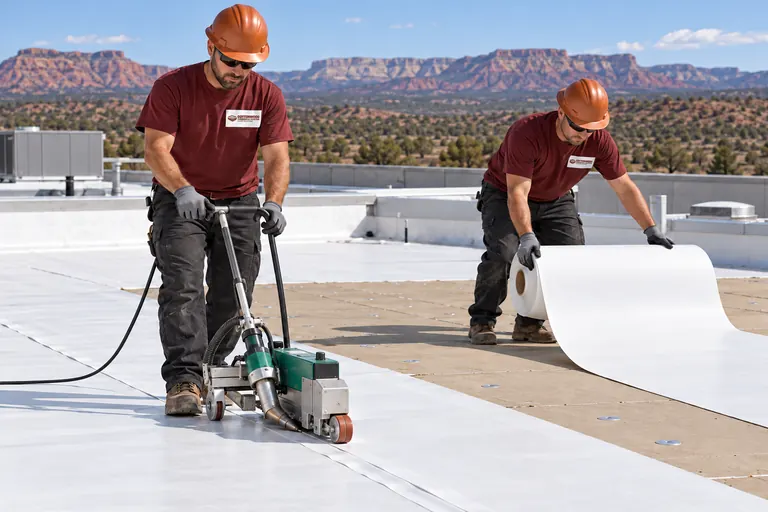
TPO For Strip Centers
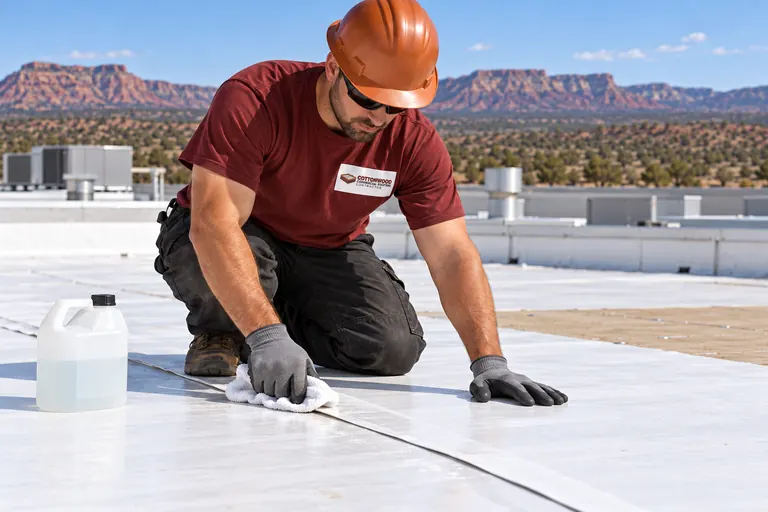
Welded seams cross suite lines without a glued joint to fail, and a white sheet keeps the rooftop unit over each tenant from working as hard in summer.
TPO roofing details
As a Verde Village commercial roofing contractor, we trace leaks across suite lines on shared retail roofs, then repair or replace the TPO or EPDM above each tenant.
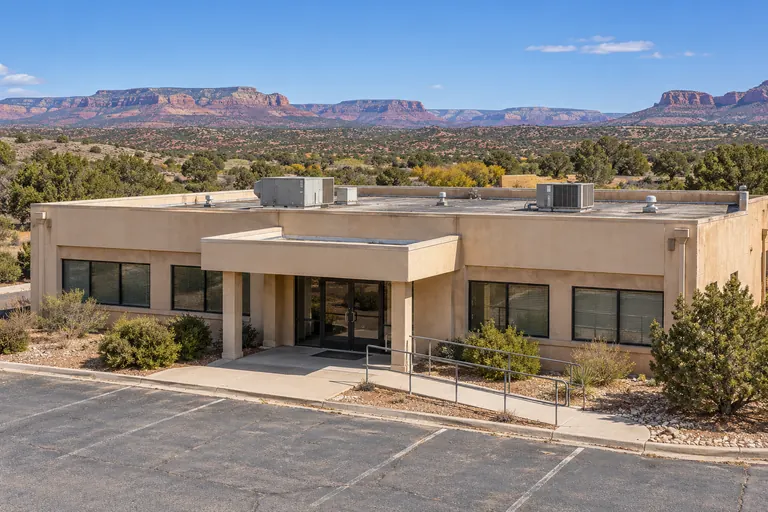 Small Commercial Building
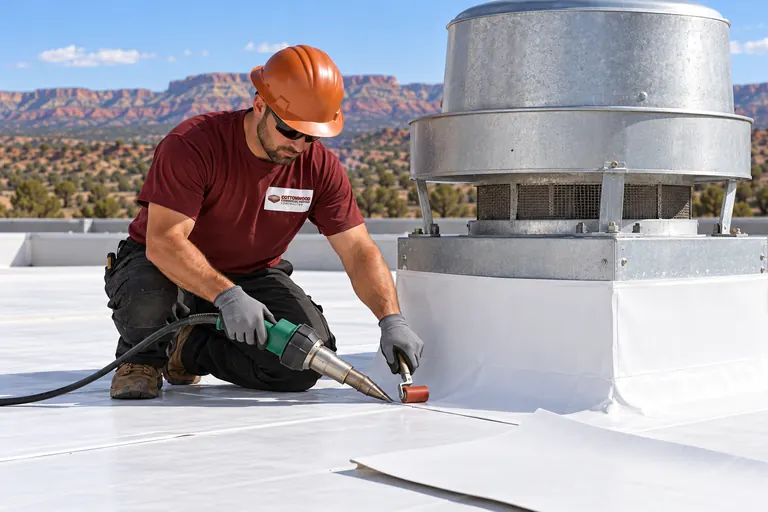 Curb Flashing
 TPO Lap Prep
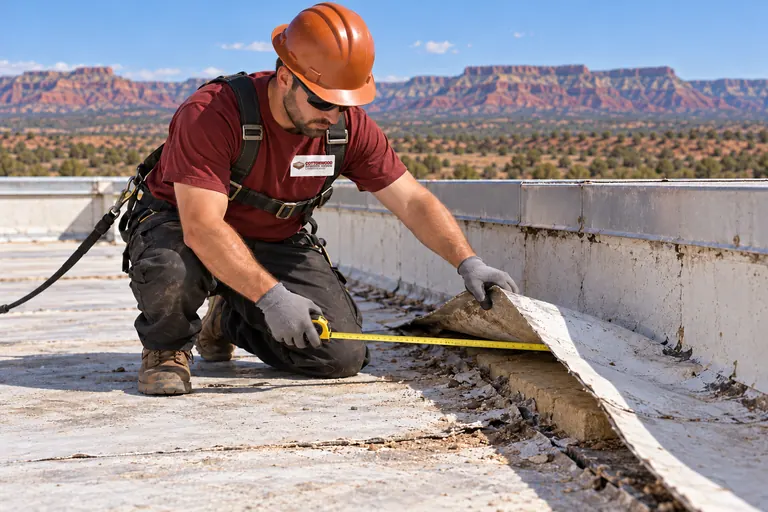
A strip center in Verde Village usually sits under one continuous roof, with a rooftop unit and a set of pipes over each tenant. Water that gets in at one curb can run along the deck or under the membrane and drip through a ceiling two or three suites away.
That is why we start on the roof, map every curb and seam above the complaint, and test the likely entry points before cutting anything open.
Tenants report the drip, and the roof shows where it started. These are the patterns we see most on strip-center roofs.
Water entering at a neighbor's unit curb and running along the deck to the lowest point.
We water-test nearby curbs one at a time and reflash the one that lets water in.
Membrane seams or old patches over the wall below, opened by daily heat movement.
Seams along that line get probed, cleaned, and rewelded or retaped.
Cracked sealant at the curb corners, or a condensate line dripping onto an open lap.
We reflash the curb, run the condensate line onto a splash pad, and close the lap.
Ponding at the back edge where a scupper sits higher than the deck around it.
We lower or clear the scupper and add tapered insulation so water reaches it.
Insulation soaked by a leak that tenants patched from inside for years.
Moisture readings outline the wet area, and only those boards are cut out and replaced.
On a shared roof, one slow leak turns into several unhappy tenants. Here is the difference a repaired roof makes.
Before The Work
After The Work
Most strip-center roofs here are single-ply membrane. These two systems cover nearly every retail roof we see.
Welded seams cross suite lines without a glued joint to fail, and a white sheet keeps the rooftop unit over each tenant from working as hard in summer.
TPO roofing details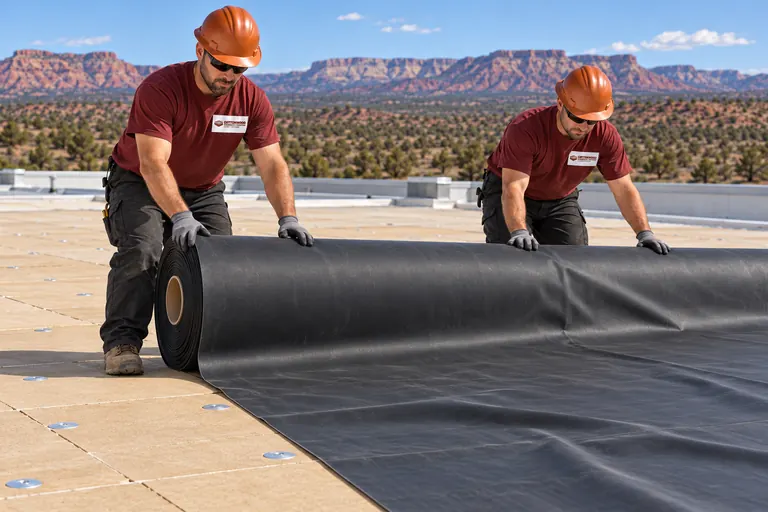
Many older retail roofs here are rubber. Taped seams and the flashing at each tenant's curb can be repaired in place before the whole roof needs replacing.
EPDM roofing detailsCall and tell us which suite, where the drip lands, and which rooftop unit sits closest. We start the trace at that curb.
Call UsFive steps, starting on the roof and ending with a walk past every tenant's curb.
We walk the full length of the strip, note every curb and seam uphill of the reported stain, and take moisture readings in a wide circle around it.
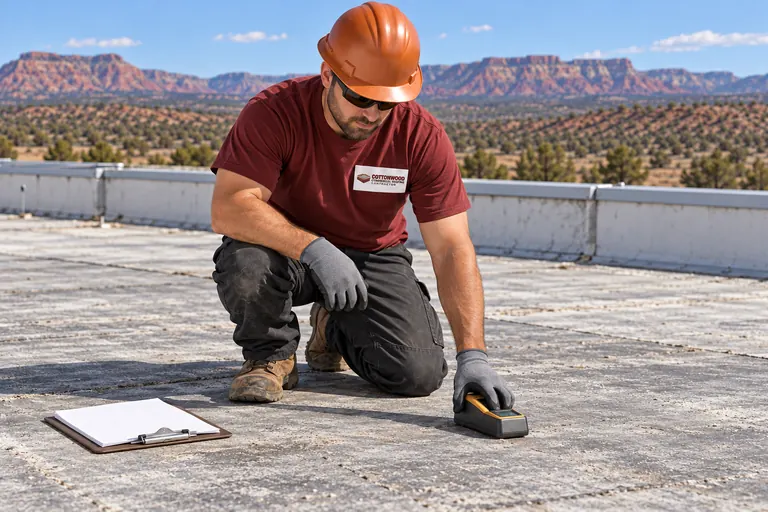
Curbs and seams above the stain get water-tested one at a time, so the leak is proven before any membrane is cut.
Repairs are listed by tenant space, each curb and seam tied to its suite, which helps owners split costs and warn tenants before roof work starts above them.
Wet boards come out, seams get rewelded, and curbs get reflashed one tenant bay at a time so storefront entrances stay open.
Finishing on the roof with you, we check each repaired curb and seam and the path water now takes to the scuppers.
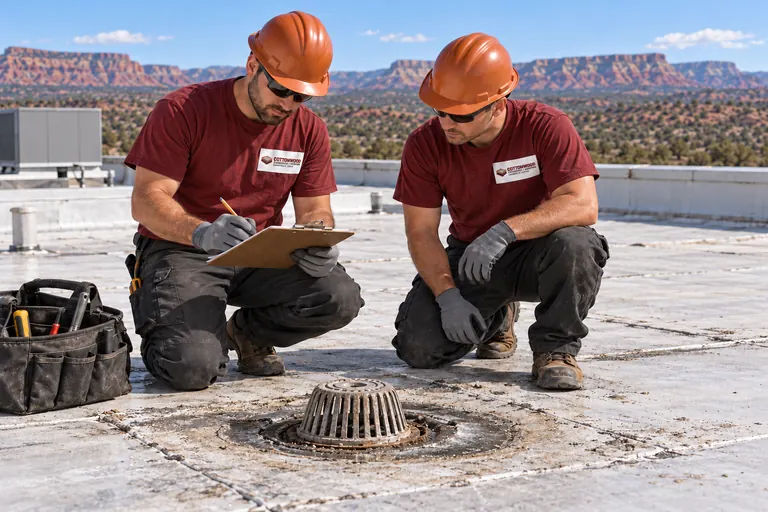
Verde Village sits right beside Cottonwood. Each neighbor brings a different roof question.
Cornville buildings tend to hold water at low corners, and winter freezes widen any crack that water reaches.
Clarkdale roofs often sit behind parapet walls, so coping and scupper details get the closest look.
Camp Verde jobs turn on moisture readings that decide between a recover and a full tear-off.
Oak Creek roofs carry dense rooftop equipment, which puts most leaks at curbs and pipe boots.
Answers for strip-center owners and property managers dealing with shared roofs.
Repair wins when the damage sits at a few seams, curbs, or punctures and the insulation underneath is still dry. On a shared retail roof, that often means fixing two or three tenant curbs and leaving the rest alone.
Replacement makes more sense when leaks keep returning across several suites, wet insulation spreads widely, or the membrane has turned brittle and shrunk. A moisture survey or core cut settles mixed signs.
That comes down to your leases, which we leave to you and your tenants. Our part is the roof side: which curb or seam let the water in, which suite sits under it, and what the repair covers, written up by suite so the cost is easy to split.
Yes, and that is how curb work usually runs on a strip center. We arrange each shutdown with the tenant or property manager, flash that curb, restart the unit, and move to the next, so each suite loses cooling or heat for a short window rather than the whole job.
Wind direction is usually the reason. Monsoon storms push rain sideways into one face of a curb or an open lap, so a leak that appears only with east winds points us to the east side of the units. Long, gentle rains instead show up where water ponds.
Verde Village is unincorporated, so permits go through Yavapai County Development Services rather than the City of Cottonwood. We confirm the requirement for your parcel before work is scheduled, since the line between city and county runs close by.
Only when most of it has failed. A roof replaced in phases can start over the worst suites and finish later, as long as the tie-ins between old and new membrane are built right. Phasing also spreads the cost across budget years.
Keep items off shelves directly under the curbs being worked on and expect some noise overhead. Entrances and parking stay usable because material is staged at the back of the building, and each tenant hears before work starts above their space.
Look at the edges. A patch with lifted corners, cracked mastic, or dirt lines running under it is letting water in. On rubber roofs, tape that has wrinkled or shrunk back from the seam edge is another sign, and every old patch gets checked and marked during the inspection.
Tell us which suites are seeing water and where the rooftop units sit. The trace starts there.
Want A Call Back About Your Roof?
Leave a name and number and we will call to talk through the roof.
Or call now: (928) 436-4826