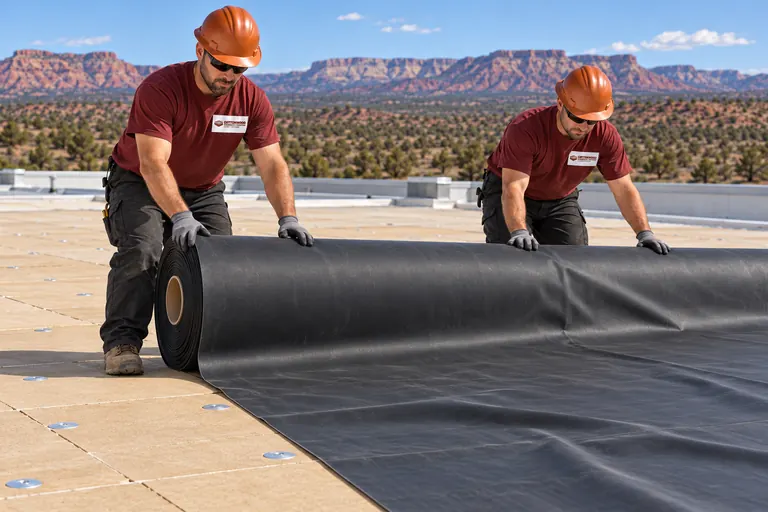
EPDM Roofing
Rubber sheets flash more easily around crowded pipe stacks and HVAC curbs, so EPDM can beat TPO on cluttered roofs.
EPDM roofing in Cottonwood
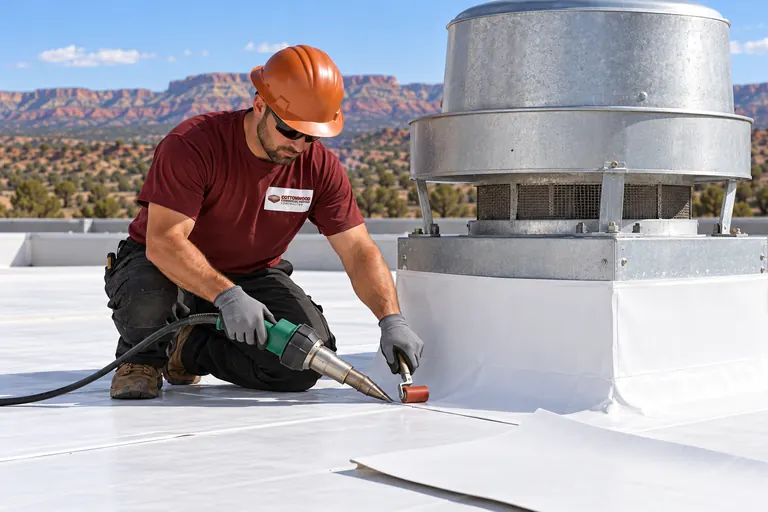
We install, repair, and replace heat-welded TPO roofs as a TPO roofing contractor serving Cottonwood retail, office, and medical buildings. Every weld gets probed before we leave the roof.
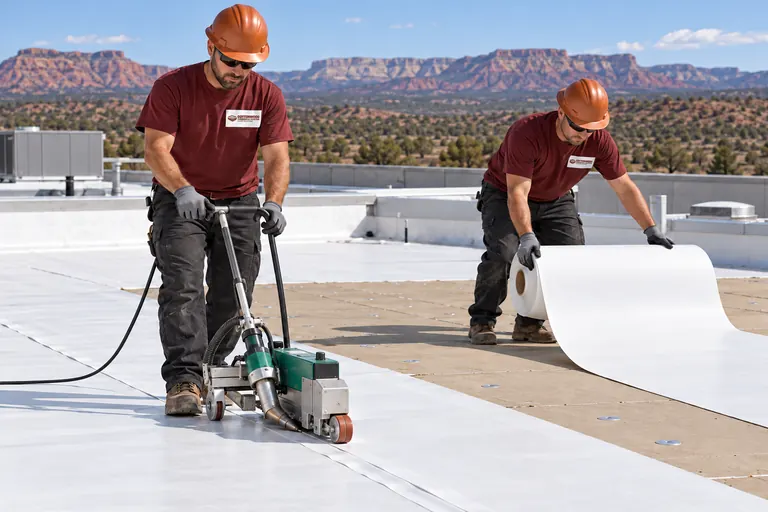 Welding Machine
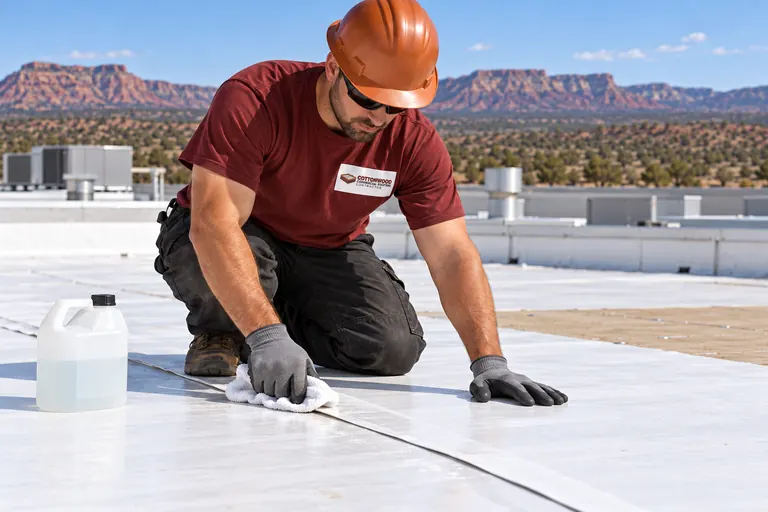 Lap Cleaning
 Curb Flashing
TPO earns its place on flat roofs over cooled space. A few roof types are better served by rubber or metal.
TPO trouble almost always starts at a weld or a curb. These are the five conditions we see most on Cottonwood roofs.
Welds made too cold or over a dirty lap never fused, and daily heating and cooling pulls them apart.
We clean the lap, reweld it with a hot-air welder, and probe the full length of the seam.
Curb flashing shrank or split at the corners where the membrane turns up the side of the unit.
New TPO flashing gets welded around the curb with preformed corners in place of cut patches.
Years of high-desert UV wore down the top layer of an older sheet until the scrim shows through.
Core cuts check what membrane is left, and worn areas get new TPO welded in.
Insulation crushed by foot traffic, or drains set higher than the deck around them.
Tapered insulation and drain sumps go in during the repair or replacement.
Monsoon gusts get under loose edge metal and work the perimeter fastening loose.
We refasten the perimeter and weld a cover strip over the new edge metal.
Moisture readings and a look at the laps decide which of these four paths your roof takes.
| Option | When It Fits | What We Do |
|---|---|---|
| Seam and curb repair | Dry insulation with a few open laps or split curb corners | Clean, reweld, and probe the laps; weld new curb flashing |
| Recover over the old roof | One existing layer, with dry boards confirmed by moisture readings | Fasten cover board and new TPO through to the deck |
| Tear-off and replace | Wet insulation across large areas, or two layers already in place | Strip to the deck, add tapered insulation, and install new TPO |
| Sheet color choice | White inside Cottonwood; tan or gray under Sedona reflectance caps | Order the color that meets the town rule before install |
Here is how a TPO roof reads on the deck before we start and once the welds are probed.
Before The Work
After The Work
Call and tell us how many seams you see lifting and where the nearest rooftop unit sits. That tells us how to stage the repair.
Call UsEach TPO job moves from testing the old laps to probing the new ones, one roof section at a time.
A seam probe runs along the old laps while a moisture meter checks the field. Wet readings get a core cut so we can see the insulation itself.
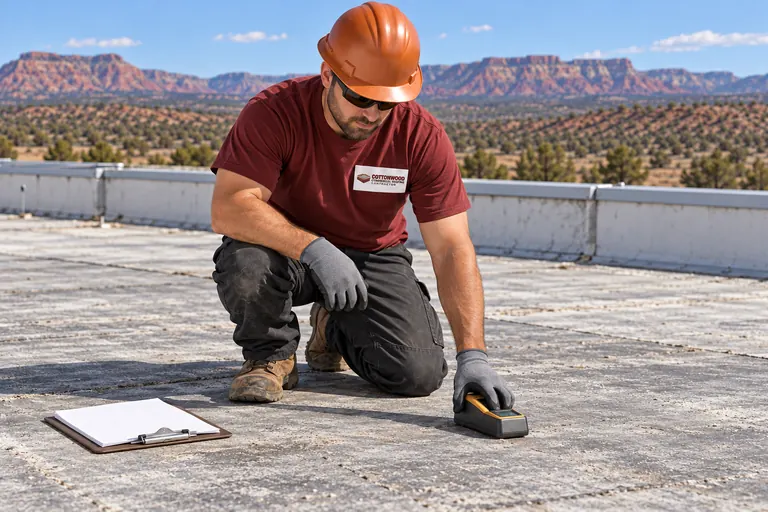
Open laps over dry boards get rewelded. A dry roof with one layer can take a recover, and wet insulation sends that section to tear-off.
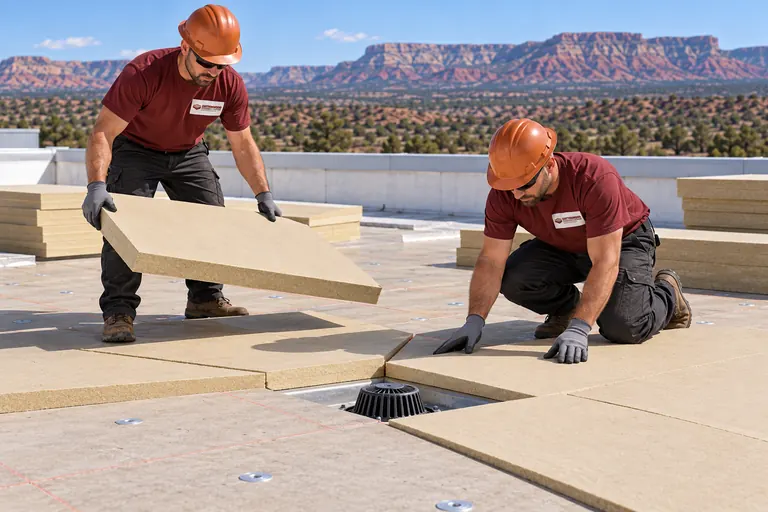
Tapered insulation is laid toward each drain and fastened with plates, so water stops sitting in the low corners of the deck.
Rolls go down with overlapping laps, and an automatic hot-air welder fuses each seam at a set heat. Curbs, pipe boots, and inside corners get hand-welded flashing.
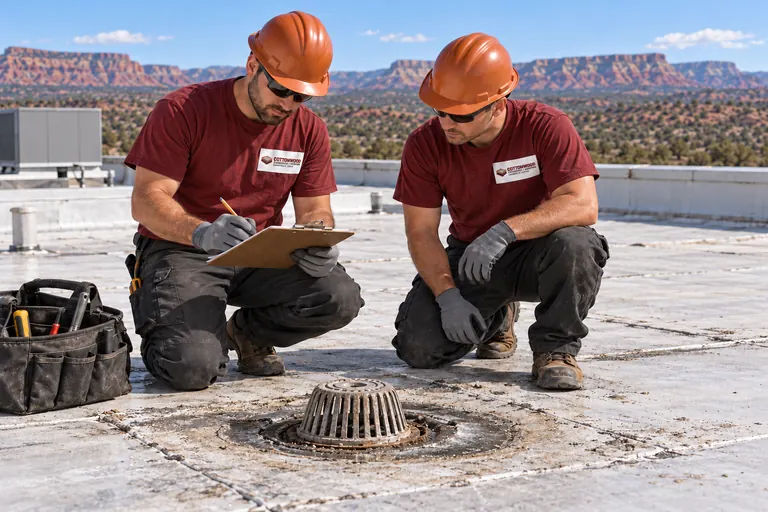
Every new weld is probed by hand, and you walk the roof with us to see drains, curbs, and edge metal before the section is signed off.
Two other roof systems come up often when owners price TPO for a Cottonwood building.
Rubber sheets flash more easily around crowded pipe stacks and HVAC curbs, so EPDM can beat TPO on cluttered roofs.
EPDM roofing in Cottonwood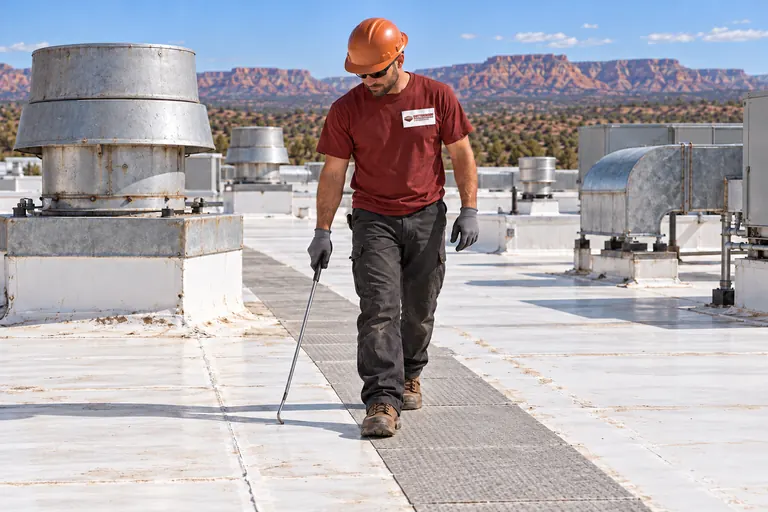
Plants and warehouses with exhaust fans and heavy foot traffic need walkway pads and phased TPO work across big decks.
Industrial roofing in CottonwoodAnswers about welded TPO membranes on Verde Valley commercial roofs.
Often, yes, for low-slope retail, office, and medical buildings. TPO is a single-ply membrane with heat-welded seams, and those seams hold when summer storms push water across the roof.
Color is the usual local caution. White helps cooling loads in Cottonwood, but the Sedona Land Development Code prohibits white or reflective roofs, so tan or gray membranes go there.
Hot air fuses the two sheets into one piece of plastic at each lap. An automatic welder runs the long field seams, and a hand welder with a silicone roller handles curbs and corners. We probe every weld afterward to catch any gap before it lets water in.
When the old roof has one layer and dry insulation, yes. Moisture readings and a core cut confirm the boards are dry, then cover board and new TPO are fastened through to the deck. Wet areas get cut out first, and two existing layers mean a full tear-off.
Curb flashing is the weak spot on most TPO roofs. The membrane turns up the side of the curb, and when the corners were cut and patched instead of preformed, they split as the roof heats and cools. New welded flashing with preformed corners fixes it.
Dust and pollen dull it over time, which lowers how much heat it reflects. Rinsing the roof during routine inspections brings back most of the brightness. Sedona roofs skip the question entirely, since tan or gray sheets are used there to meet the reflectance limits.
Thicker sheets hold up better to foot traffic and hail, and they leave more material to weld into on future repairs. We match thickness to rooftop traffic and the number of units on the deck, and the choice is written into the scope.
Roof size sets the base, then the work underneath moves it most. Wet insulation that must come out, tapered insulation to fix ponding, the number of curbs and pipes to flash, and sheet thickness all add labor or material. A recover over a dry roof costs less than a full tear-off.
Send us the roof size and what you see at the seams, and the first visit starts with a probe test on the old laps.
Want A Call Back About Your Roof?
Leave a name and number and we will call to talk through the roof.
Or call now: (928) 436-4826