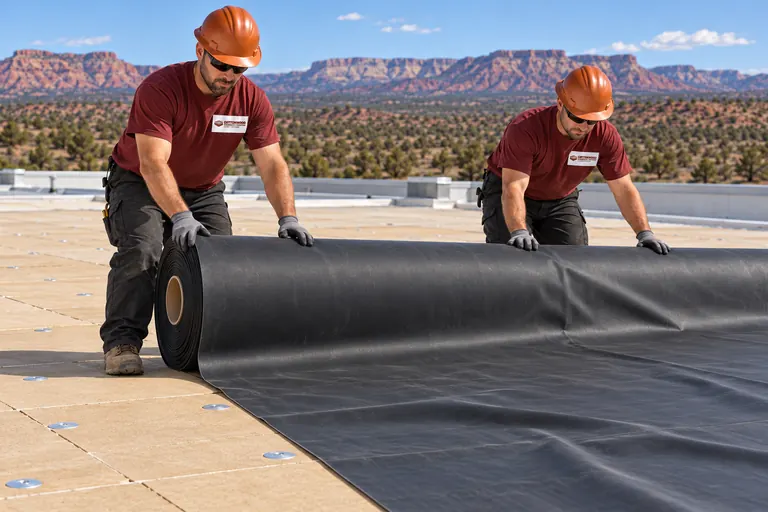
EPDM Around Equipment
Rubber flexes around odd shapes and tight clusters of pipes, and new flashing bonds well to an older EPDM field sheet.
EPDM roofing details
Rooftop units, vents, and pipe boots cause most Village of Oak Creek roof leaks. As an Oak Creek commercial roofing contractor, we flash them and repair the roof around them.
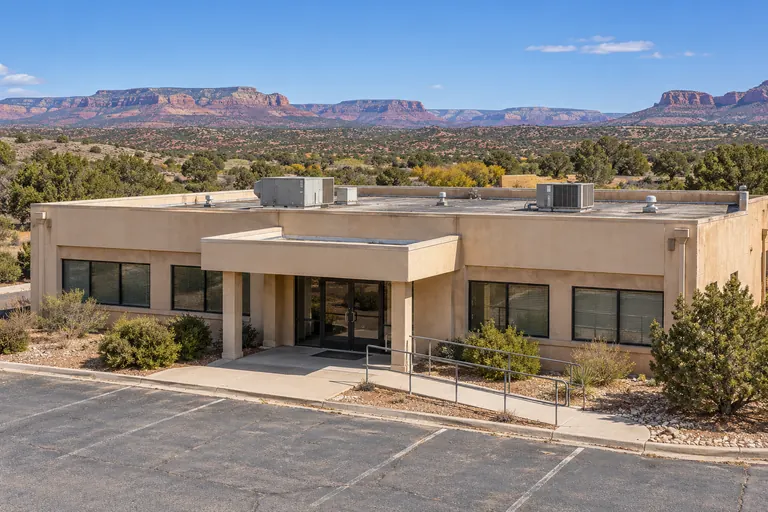 Single-Story Commercial Roof
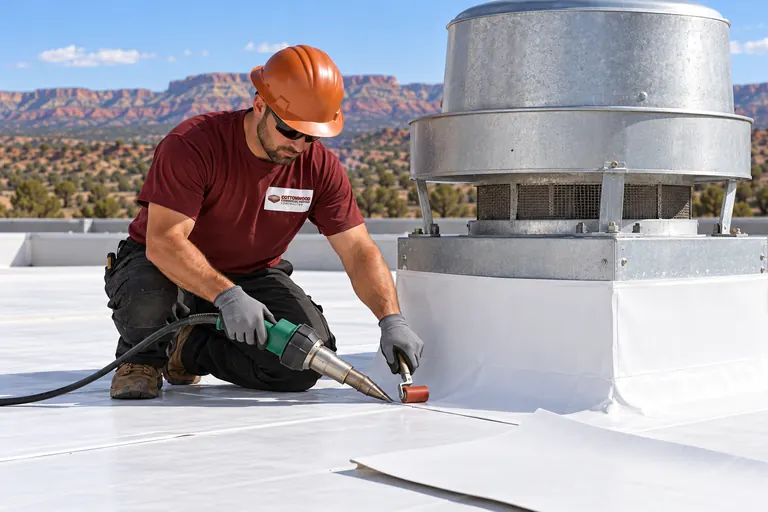 Exhaust Fan Curb
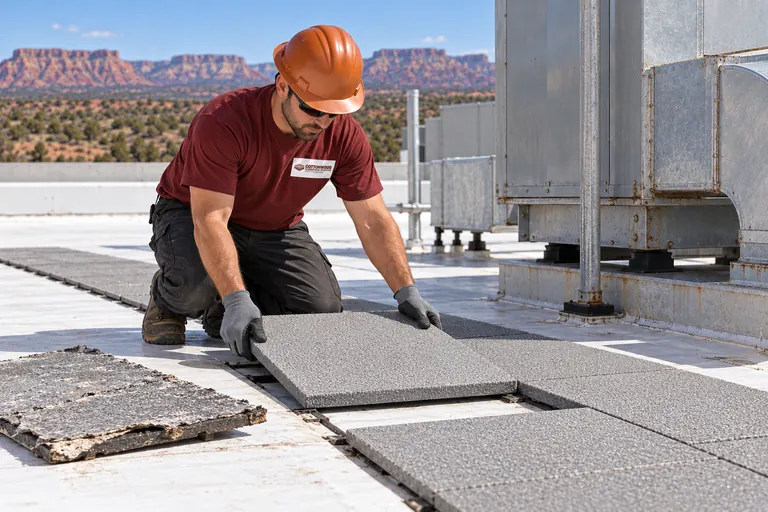 Walkway Pad Repair
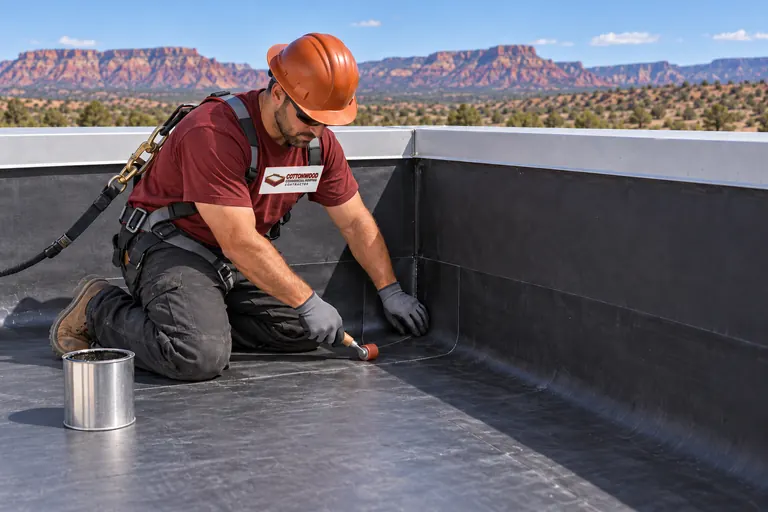
Single-story commercial roofs in the Village of Oak Creek tend to carry a lot of equipment: package units, exhaust fans, plumbing vents, gas lines on pitch pans, and conduit to rooftop disconnects. Every one of those breaks the membrane, and each break needs its own flashing.
Before we price anything, we also confirm the parcel. Addresses near Oak Creek Canyon can fall outside the village, which changes who issues the permit.
Each piece of equipment fails in its own way. These five turn up on roof after roof around the village.
Sealant at the curb corners dried out, or counterflashing pulled loose during a service call.
We strip the old corners, reflash the curb with matching membrane, and refasten the counterflashing.
A rubber pipe boot cracked by sun, with its top clamp slipped down the pipe.
The boot gets replaced and clamped, and the membrane around its base is checked for splits.
Pitch pan filler that shrank away from the pipe and left a gap at the edge.
We refill the pan or swap it for a prefabricated flashing that holds without refilling.
Fan curbs set too low, so ponding water rises over the top of the flashing.
We raise the curb where needed and flash it with new membrane.
Service techs kneeling and dropping screws on bare membrane around the units.
Walkway pads go down along the service path and around each unit.
Equipment leaks start small and spread under the membrane. Here is the roof before and after the curb work.
Before The Work
After The Work
Equipment-heavy roofs here are usually single-ply. These two systems handle penetrations best.
Rubber flexes around odd shapes and tight clusters of pipes, and new flashing bonds well to an older EPDM field sheet.
EPDM roofing details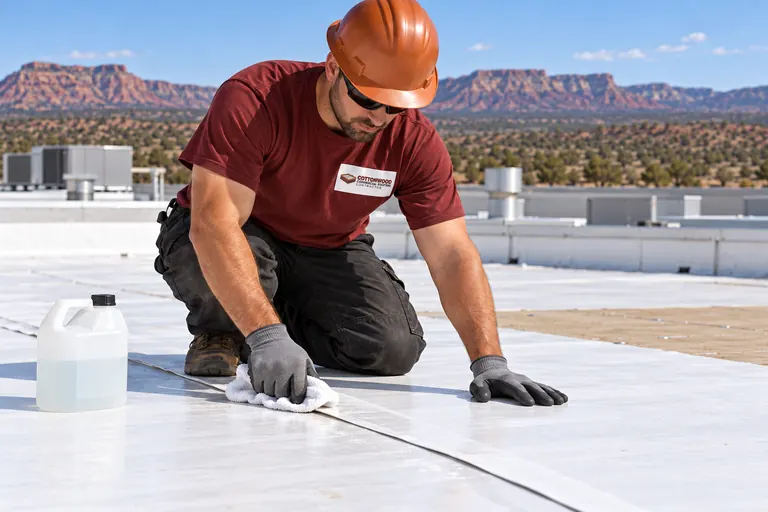
Prefabricated TPO corners and pipe boots are welded to the field sheet, which leaves no glued joints at the spots where most leaks begin.
TPO roofing detailsCall with the unit's location and when the drip appears, during rain or while the unit runs. That tells us whether to look at the curb or the condensate line.
Call UsWe work unit by unit, starting with a full inspection and ending with every curb rechecked.
We photograph each unit, curb, vent, and pan, then take moisture readings in a ring around every penetration to find water that has spread under the sheet.
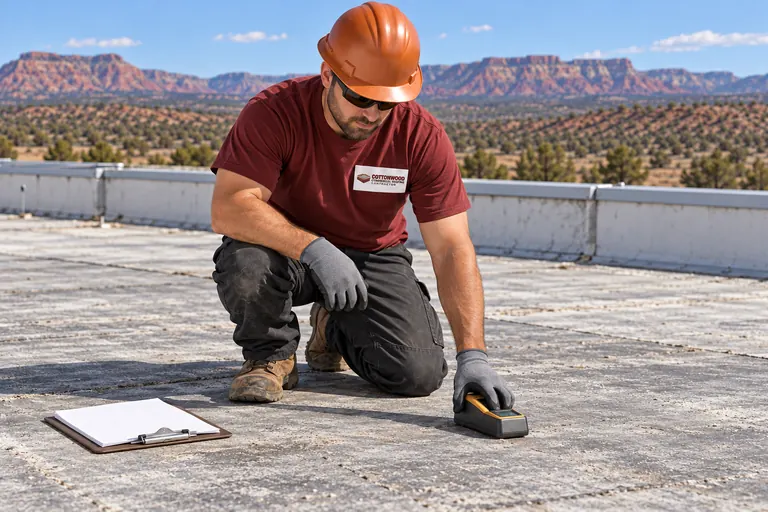
Village of Oak Creek addresses go through Yavapai County, but properties near Oak Creek Canyon can sit outside the village line, so we look up the parcel before any roof work is priced.
HVAC units come off one at a time, arranged ahead with whoever runs the building, so only one zone loses cooling or heat while its curb is flashed.
Old sealant and patches come off down to clean membrane, then new curb corners, boots, and pan flashings are welded or taped in.
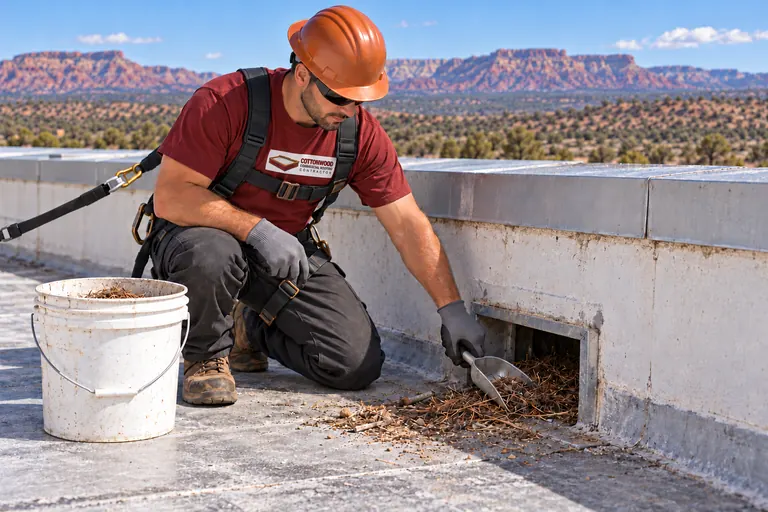
Debris from around the equipment ends up in the scuppers, so drains are cleared and every curb is checked again before we leave the roof.
Oak Creek sits between Sedona and the I-17 corridor. These nearby towns are covered too.
Sedona roofs must avoid white and reflective surfaces, so membrane and metal colors get chosen early.
Rimrock jobs focus on roof edges, coping, and gutters that catch the full force of storm gusts.
Low corners on Cornville roofs collect water that freezes overnight and opens cracks.
Strip-center roofs in Verde Village need leaks traced across several tenant suites.
What building owners in the Village of Oak Creek ask about equipment, flashing, and permits.
Twice a year works for most roofs: once in spring before monsoon season and again in fall once it ends. Add a visit after severe wind, hail, or heavy snow.
On an equipment-heavy roof in the Village of Oak Creek, each visit should cover every curb, pipe boot, and pitch pan, plus clearing leaves and dust from drains and scuppers.
Check the parcel, since the mailing address alone can mislead. The village is unincorporated Yavapai County, while Sedona is a city with its own building department and stricter roof color rules. Properties near Oak Creek Canyon sometimes fall outside the village, and we confirm which side of the line yours sits on.
Pitch pans hold a pourable sealer around a pipe, and that sealer shrinks and cracks as it ages in the sun. Once a gap opens at the edge, water runs straight down the pipe. Refilling buys time, and a prefabricated pipe flashing welded or taped to the membrane ends the cycle.
Yes, with your HVAC service company handling the disconnect and reconnect. Lifting the unit lets us rebuild or raise the curb, replace wet insulation underneath, and flash the new curb properly. It is also the best time to fix a curb that sits too low for the roof around it.
Condensate is the usual answer. A clogged or cracked condensate line drips onto the roof, and when that water lands on an open lap or a curb corner, it finds its way inside on dry days. We trace the line, reroute it to a drain or splash pad, and seal the spot it was hitting.
They do on roofs that get regular service visits. Techs carrying tools and parts wear paths in the membrane and drop screws that get stepped into the sheet. Pads along the path from the hatch to each unit take that wear instead and are simple to replace.
Every new unit, vent, or conduit run cuts another hole in the membrane. When the installer seals it with mastic alone, the flashing fails within a few seasons. We flash new penetrations to match the roof system and add them to the roof plan so the next inspection checks them.
Abandoned curbs and vent stubs are leak points that serve no purpose. When the equipment is gone, we cut the curb out, fill the opening with deck and insulation, and patch the membrane over it, which leaves fewer flashings to maintain.
Tell us how many rooftop units you have and where the stains are. We start at the curbs closest to the water.
Want A Call Back About Your Roof?
Leave a name and number and we will call to talk through the roof.
Or call now: (928) 436-4826